
Social media is the number one tool for business marketing and will continue to be so for a long time to come. Working in the marketing and social media industry, we see how often social media platforms are updating, improving, or adding features and services to their apps. Even for professionals like us, we are constantly learning and adjusting to these changes. For regular social media consumers, or small business owners who handle their own accounts, all these features and updates can be overwhelming or can leave you wondering if there’s any difference between them at all. What will always be most important in these apps are the content you are putting out there. Whether its regular feed content or paid advertisements, this is what people are seeing about your business and therefore what matters most. But what is the difference between the two, and which would be more beneficial to your small business? That’s what we are going to dissect today.
What’s the difference?
First, let’s establish the difference between feed posts and paid advertisements, both in functionality and direct business impact. For this blog, we are only focusing on Facebook and Instagram, which if you didn’t know, are connected through Meta Business Suite. A feed post costs no money to upload, will appear on a viewer’s home page, and live permanently on your profile. These can be simple square or rectangle graphics, photographs, or a reel/video. Paid advertisements appear in the same format; a square or rectangle graphic, photo, or video reel. These, however, require a different approach when posting, cost money, and most of the time, do not live permanently on your profile. Additionally, paid advertisements only run for an established period.
What are the benefits? – Feed posts
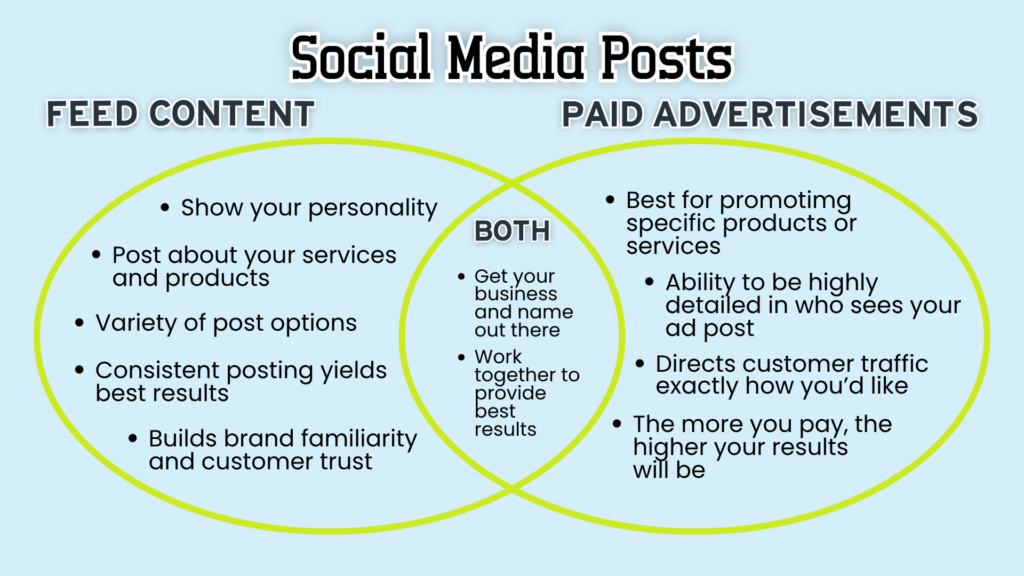
Let’s look at the benefits for feed posts. Making consistent feed posts are a great way to keep your business and its name out there. Feed posts, depending on your business, can be something as casual as a selfie outside of your office to a whole choreographed video reel with a crew of your employees. Other great things to post to your feed are special products or services, informational graphics about your business, behind the scenes photos or videos, and posts that show off your personality. People love variety and they also love seeing other people on their social media. Repetitive graphics and unrealistic stock imagery is always outperformed by differentiating graphics and photos of real people in familiar spaces. Think of your profile feed as a place where viewers can learn everything about your business, a more live-action and personable version of your website.
Despite what you may think, virality should never be the goal behind your feed posts. The goal should be to simply show off your business. Many of our clients say, or even you yourself may be thinking, “I don’t have a lot of followers, I know I won’t get a lot of engagement.” That’s okay! The goal for social media is not to gain thousands of followers and have your posts get millions of views and likes. If that happens, of course it is wonderful. But that is tricky to achieve, trickier to maintain, and comes with a heightened boost of exposure that many businesses aren’t prepared for.
The most important factor and what we tell our customers is that an active social media feed shows your business is up to date, reliable, and invested in their online presence. This is very important to the younger generations who rely heavily on social media and the internet when it comes to supporting businesses. If someone is researching lawn care companies near them, they are more likely to choose the company that has been posting consistently on social media than a business whose latest post was 18 months ago.
What are the benefits? – Paid advertisement posts
Now, let’s talk about paid ads on Facebook and Instagram. These are a great options for those who have a product or service that they want to target to a specific demographic, or if they want to push their business out to boost guaranteed results. What does that mean? Let’s take a look at how these operate.
For Facebook ads, you can completely customize every behind-the-scenes aspect of your post. When you create an ad, Facebook takes you out to Meta Business Suites and asks what your goal is: gain more followers, boost website visitors, receive more phone calls, get more messages, etc. You can choose how you will direct people who are interested in whatever it is you’re promoting. Then you’ll upload your media and text, and depending on your goal, provide Facebook with the link to your website or telephone number. After that, you can get even more specific with your audience.
Facebook provides what’s called “detailed targeting”, allowing you to cherry pick who sees your ad. You can set geographical locations, where only people in those areas will see your ad and even distinguish between genders and ages. This is pretty basic targeting, but it can get more specific. We all know the information we put in our bio, all the pages we like and follow right? Well, Facebook uses that information and funnels people into demographics based on all of that information. So, if you had a school pride t-shirt design that you created for teachers, and wanted to make a Facebook ad for it, you could apply the following targeted demographics: female elementary school teachers aged 22-45 at XYZ school district, male high school teachers with multiple children in college aged 40-65 at XYZ district, retired teachers in the XYZ area. The details can get quite detailed, which is a little frightening, but assures the exact people you want to see your ad will.
At the end, you will set your monetary budget for the ad. It’s important to note though; no matter what your ad looks like, no matter how detailed or generic you set your audience targeting, the more money you give Facebook to push your ad, the better results you will get. It’s important to note with paid ads, these do not live permanently on your feed (unless you choose to boost an existing post, and “boost” just means to pay and set up like an ad). So, you cannot search for the ad on your page or feed while its running or after.
Unlike Facebook, Instagram does not have the “create ad” feature, but you can still “boost” your posts like on Facebook to get them across to more people. If you click “boost post” on an existing Instagram post, it will take you out to Meta Business Suite, and you will have a similar process as with Facebook.
What’s best for my business?
In all honestly, you should have both feed posts and paid ads. Both of these should work in tandem and will provide the best opportunity for your business to succeed both online and in revenue. If one of your paid ads comes across a user’s feed, and they want more information, they’ll likely visit your page. With an active page, they can learn more about you, see other services and products you offer, and get the impression that your business truly cares about its customers and success.
The social media specialists at Atwill Media are professionals at navigating the ins and out of Facebook, Instagram, and all of their features. Social media shouldn’t be something to stress over, but if it is, call Atwill Media. We can take the stress off your plate and help your business thrive online.